Trovelore Lapwing Bird Brooch Pin
**PREORDER FOR FALL OCTOBER 2026**
Why You'll Love It
The Lapwing is the bird that most people walk past without looking, and one of the most beautiful birds in Europe when you do.
The Northern Lapwing (Vanellus vanellus) is a wading bird of farmland, wet meadows, and marshes found across Europe and temperate Asia, immediately recognizable to anyone who knows it by three things, the long wispy crest that arches backward from the crown, the tumbling, erratic display flight accompanied by the haunting peewit call that gives the bird one of its alternative names, and the extraordinary iridescence of the back feathers that shifts between deep green, purple, and bronze depending on the light. In Britain the Lapwing has declined significantly over the past half century due to agricultural intensification, and it is now on the conservation watchlist, a bird that was once so common it defined the British countryside and is now a cause of genuine concern among naturalists and birders.
The Lapwing's beauty rewards exactly the kind of close attention that most people never give it. Seen properly, in good light, the back feathers produce one of the most complex structural iridescences of any European bird, shifting through green, teal, purple, and bronze as the angle changes. The bold black and white facial pattern and breast band give the bird a graphic, immediately striking quality. The long crest, which can be raised and lowered as a display and communication device, is one of the most distinctive features of any European wader. And the warm amber-orange undertail coverts, visible in flight and at rest, provide a vivid chromatic surprise in what otherwise appears to be a black and white bird.
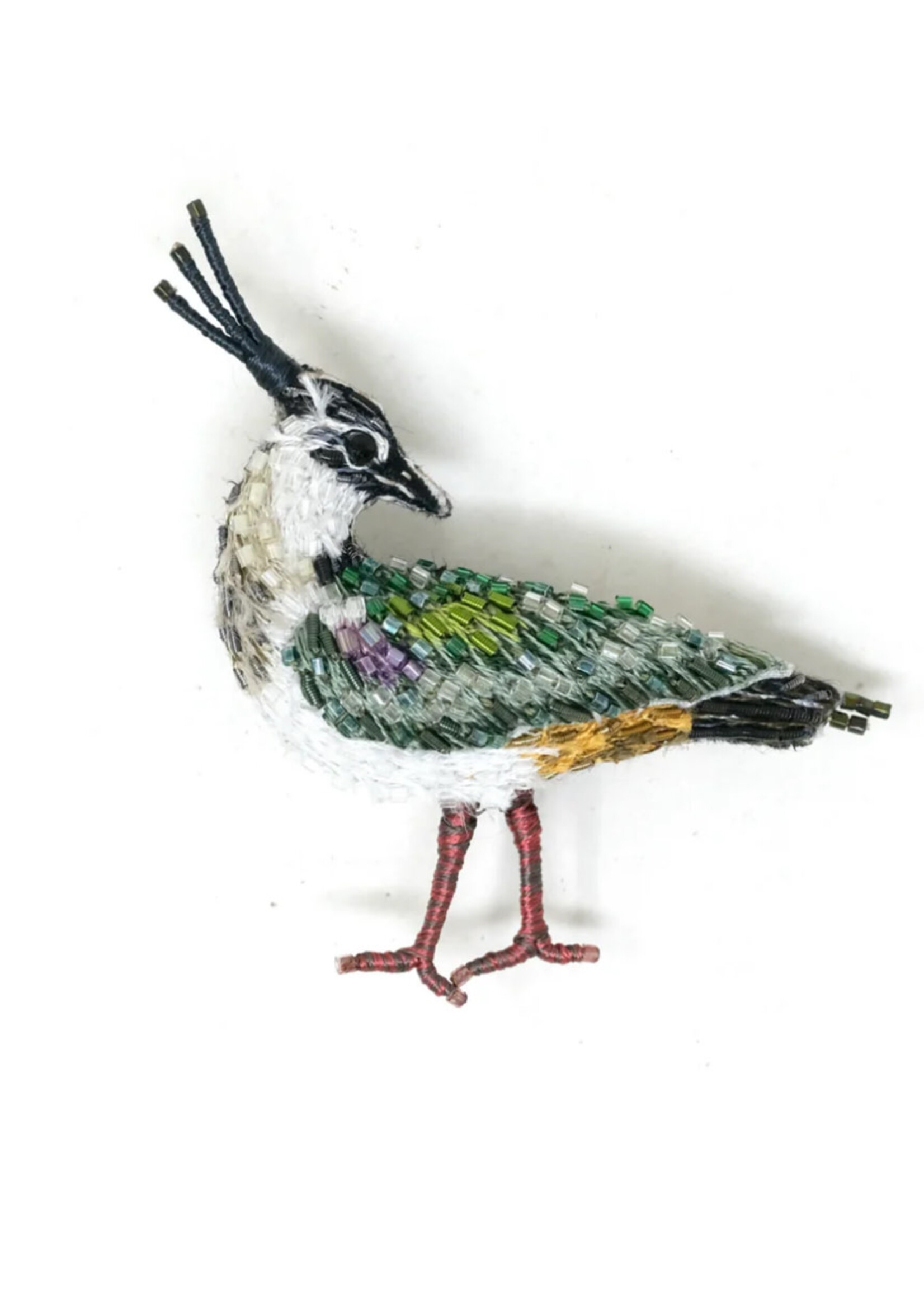
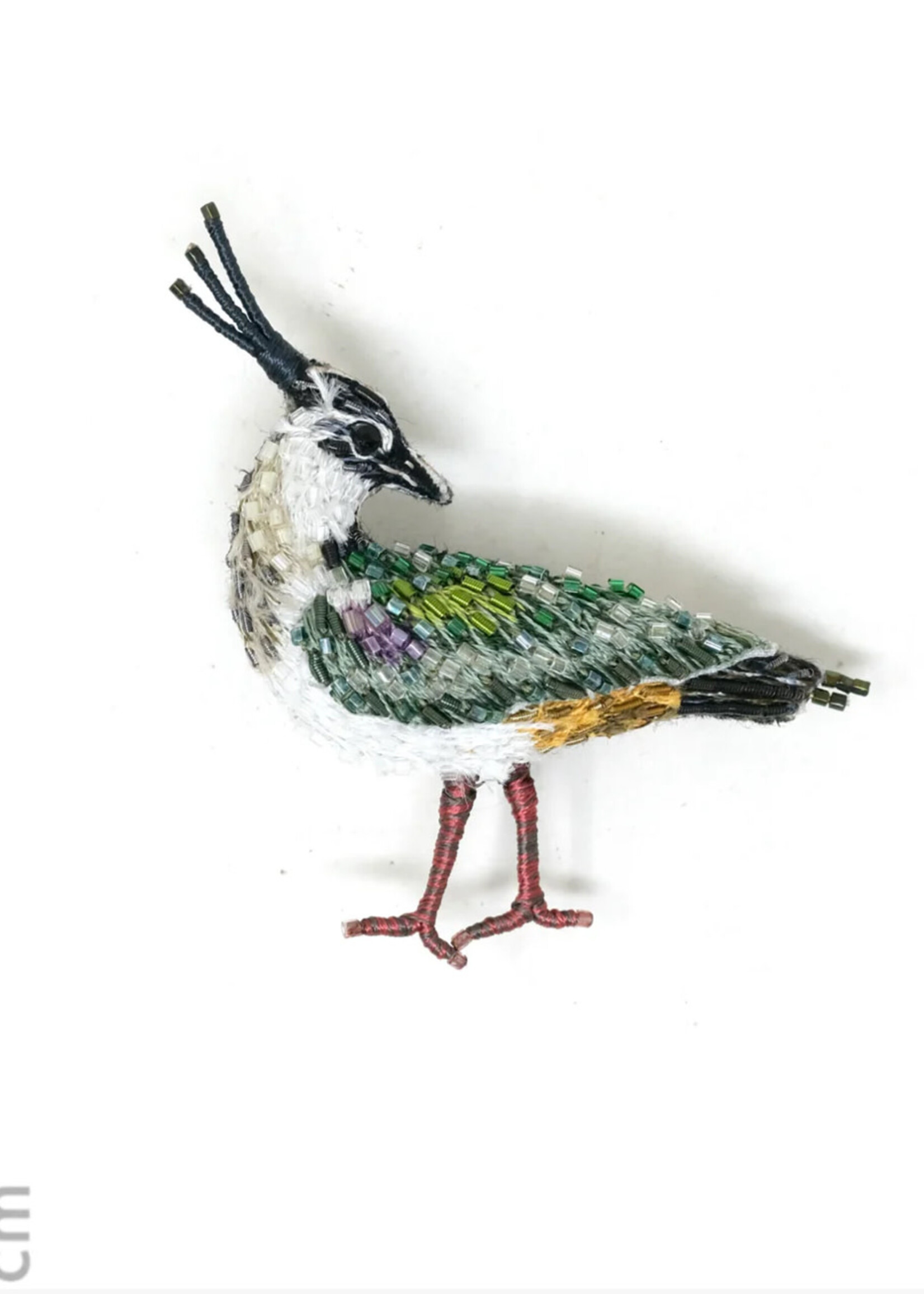
Trovelore's Lapwing Bird Brooch Pin captures all of this with ornithological accuracy of a high order. The bird is shown in a characteristic alert standing posture, head slightly raised, body compact and rounded, exactly the posture of a Lapwing pausing between feeding to scan for danger. The wispy crest is rendered in three fine dark navy-black beaded strands extending upward from the crown with the delicacy the real feathers require. The black and white facial pattern, including the bold mask, white cheek patch, and black breast band, is worked with precise embroidery and jet beads. The back and wing coverts are built up in iridescent green seed beads in multiple tones from olive to emerald to teal, with a band of soft purple-violet beads at the wing bend that precisely replicates the Lapwing's characteristic wing iridescence. A vivid warm amber-gold patch at the undertail is worked in bright gold beads that provide the one warm chromatic accent in the composition. The legs and feet are rendered in fine terracotta-red embroidery thread with individual toe detail that gives the bird its characteristic red-legged standing posture.
At 2.4" tall by 2.4" wide (6 cm x 6 cm) the Lapwing is a perfectly square piece, the upright standing posture giving it a vertical presence within that square format that feels entirely true to the real bird's alert, watchful character.
It arrives in Trovelore's embossed keepsake box with a story card, ready to wear or give.
This is a preorder item. The August allocation has sold out. We expect our next Trovelore shipment in October 2026 and will ship your order immediately upon arrival.
Size and Details
- Dimensions: 2.4" tall x 2.4" wide (6 cm x 6 cm), a perfectly square piece with the bird shown in upright alert standing posture
- Materials: Cotton, felt, metal pin back, dark navy-black seed beads for crest strands, iridescent green and teal seed beads in multiple tones for back and wings, purple-violet beads for wing bend, amber-gold beads for undertail, jet black beads and white embroidery for facial pattern and breast band, terracotta-red embroidery thread for legs and feet, and hand embroidery threads throughout
- Construction: Hand embroidered and hand beaded by skilled artisans with careful ornithological attention to plumage detail and posture
- Made in India in small production batches
- Arrives in Trovelore's embossed keepsake box with Lapwing story card
- Minor natural variations in iridescent bead tone, crest strand placement, and embroidery detail between pieces are an inherent and celebrated characteristic of handmade craft, not a defect
Care Instructions
- Gently surface clean with a soft dry microfiber cloth if needed, do not wet
- Store flat in the keepsake box to preserve the wispy crest bead strands, which are the most delicate structural elements of this piece
- Keep away from moisture, humidity, and prolonged direct sunlight
- Avoid direct contact with perfume or hairspray
- Do not machine wash any garment with the brooch attached
- Do not store with other brooches where the crest strands and leg embroidery can be snagged or compressed, individual flat storage is recommended for this piece
Styling Tips
- Pin to a simple black, white, cream, or warm linen top where the iridescent green back, black and white facial pattern, and amber undertail read with full ornithological clarity
- The iridescent green and teal back palette works beautifully against deep navy, forest green, warm cream, and natural linen
- The amber-gold undertail accent makes this piece particularly warm against camel, terracotta, and warm earth tone outfits
- The upright standing posture and square format sit beautifully on a wider lapel where the full bird silhouette, crest to feet, can be appreciated
- A natural companion to the Wild Mallard, Homing Pigeon, and Fork-Tailed Swallow for a curated European farmland bird collection
- One of the most ornithologically faithful bird pieces in the collection, ideal for serious birders who will immediately appreciate the plumage accuracy
- A meaningful conservation gift for anyone who cares about the declining farmland birds of Europe and Britain
- Display in the keepsake box as a natural history art object when not wearing, the standing posture makes it as compelling upright in a box as on a lapel
- Converts to a pendant necklace with a bail adapter, available separately on Amazon
A Bird Worth Saving
The Northern Lapwing was once one of the most abundant birds in the British countryside. In the early twentieth century lapwings were so common that their eggs were legally collected and sold as a delicacy, a practice that continued until the 1920s. Since then, agricultural intensification, earlier cutting of grass for silage, drainage of wet meadows, and the move from spring to autumn plowing, has reduced Lapwing breeding success dramatically. The UK population has declined by over 80 percent since the 1960s. Similar declines have occurred across northern and western Europe.
The Lapwing is now on the UK's Red List of Birds of Conservation Concern. Its distinctive tumbling display flight and peewit call, once the defining sounds of the British spring countryside, are heard far less frequently than a generation ago. Conservation efforts including agri-environment schemes that reward farmers for maintaining wet meadows and avoiding early grass cutting have helped stabilize some populations, but the Lapwing remains a species in genuine difficulty.
Wearing a Trovelore Lapwing brooch is a small, beautiful way to celebrate and draw attention to one of Britain's most beloved and most threatened farmland birds.
The Perfect Gift
The Lapwing is one of the most ornithologically detailed and conservation-resonant bird pieces in the Trovelore collection. It works for European birders and British naturalists who know and love this species, for anyone who has heard the peewit call across a wet meadow and felt something lift in response, for conservation-minded recipients who care about the declining farmland birds of Europe and Britain, for lovers of iridescent green jewelry with genuine ornithological grounding, and for anyone who wants a bird brooch that rewards the same kind of close attention the real bird does. The complete keepsake presentation means it arrives ready to give.
FAQs
What is the Northern Lapwing?
Vanellus vanellus is a wading bird found across Europe and temperate Asia, breeding on farmland, wet meadows, and moorland. It is immediately recognizable by its long wispy crest, bold black and white facial pattern, iridescent green and purple back, and distinctive tumbling display flight accompanied by the haunting peewit call that gives it one of its alternative names. It has declined dramatically across much of its European range due to agricultural intensification and is now a conservation priority species.
Is the Lapwing in decline?
Yes, significantly. The UK breeding population has declined by over 80 percent since the 1960s, and similar declines have occurred across northern and western Europe. The primary driver is agricultural intensification, particularly the switch from spring to autumn plowing, earlier silage cutting, and drainage of wet meadows that the Lapwing requires for successful breeding. It is now on the UK's Red List of Birds of Conservation Concern.
What makes the Lapwing's back feathers iridescent?
The Lapwing's back feathers produce structural iridescence through the same mechanism as the peacock feather and many butterfly wings, the microscopic physical structure of the feather barbules refracts light differently at different angles, producing colors that shift between deep green, teal, purple, and bronze without any change in pigment. In good light a Lapwing's back is one of the most complex and beautiful iridescent surfaces of any European bird.
Why is the August allocation sold out?
The Lapwing proved more popular than anticipated in our August preorder allocation. We have secured additional quantity in our October shipment. Preordering now is the best way to guarantee availability.
How large is this brooch?
The Lapwing Bird Brooch Pin measures 2.4" tall by 2.4" wide (6 cm x 6 cm), a perfectly square piece with the bird shown in upright alert standing posture, crest to feet, giving the piece a vertical presence within the square format that is true to the real bird's watchful character.
What does it arrive in?
Every Lapwing Bird Brooch Pin arrives in Trovelore's embossed keepsake box with a story card. It is ready to gift exactly as it arrives.
What is your return policy on preorder items?
Our standard 14-day return policy applies to this item. Returns are accepted within 14 days of delivery for store credit. If you have questions about the piece before purchasing, please reach out and we will do our best to help.