Trovelore Red Spotted Purple Butterfly Brooch Pin
**PREORDER FOR FALL OCTOBER 2026**
Why You'll Love It
Some butterflies announce themselves from across a meadow. The Red-Spotted Purple waits for you to come close.
The Red-Spotted Purple (Limenitis arthemis astyanax) is one of North America's most striking and most underappreciated butterflies, found across the eastern United States from New England through Texas and into the Deep South, inhabiting woodland edges, river valleys, and coastal plain habitats where it basks on sun-warmed leaves and paths with wings spread flat, fully exposing the iridescent blue-black upperside that gives it its name.
The name is slightly misleading. The butterfly is not red and purple in the way those words commonly suggest. The upperside is a deep, moody blue-black, shot through with an iridescent blue and violet postmedian band across the hindwings that shifts from cobalt to electric blue to soft purple depending on the light and viewing angle. The forewing upperside carries warm brick-red and copper-orange submarginal spots along the outer margin, the red spots of the common name, muted and warm against the dark ground rather than vivid. The underside, which is what gives the species its full common name, carries bolder red-orange spots on a brown and blue ground. The overall impression of the upperside is of something nocturnal and jewel-like, dark, iridescent, and more beautiful the more carefully you look at it.
The Red-Spotted Purple is also a celebrated example of Batesian mimicry. It closely resembles the Pipevine Swallowtail, a butterfly that is toxic to predators due to the pipevine plants its caterpillars feed on. By mimicking the Pipevine Swallowtail's dark iridescent appearance, the Red-Spotted Purple gains protection from bird predators without being toxic itself. It is one of the most studied examples of mimicry in North American entomology.
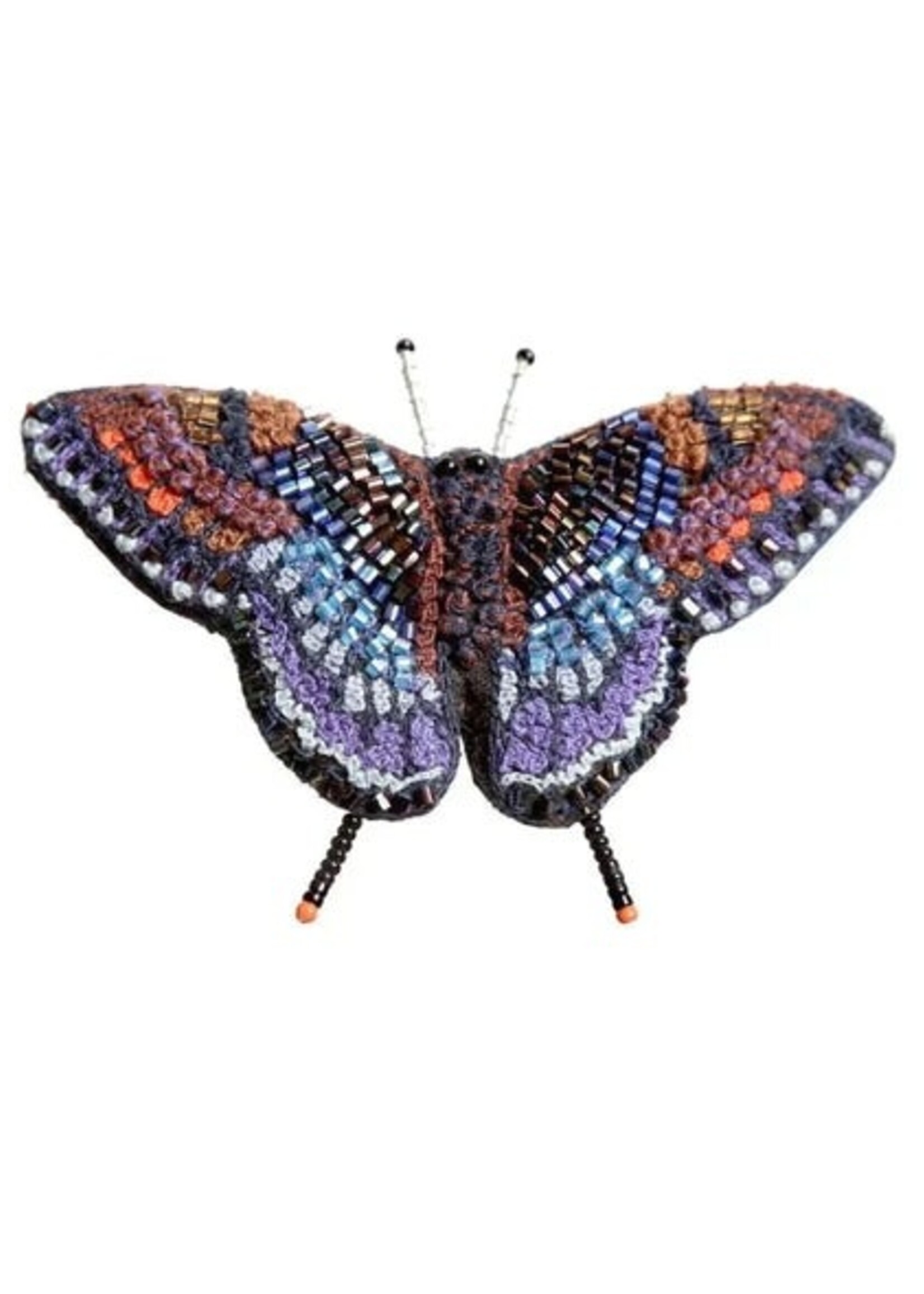
Trovelore's Red Spotted Purple Butterfly Brooch Pin captures the butterfly's characteristic moody, jewel-like upperside with a palette of extraordinary depth and sophistication. The upper forewings carry warm terracotta and copper-orange embroidery and beads that grade into deep iridescent blue-black toward the wing tips. The hindwings display the species' iridescent postmedian band in vivid cobalt, electric blue, and soft purple beads that shift in light exactly as the real butterfly's structural color does. Pearl-white submarginal spots on the hindwing edge are worked in precise pearl beads. The antennae are fine dark beaded strands tipped in small orange-coral beads that echo the warm spot colors of the forewing.
At 1.8" tall by 2.75" wide (4.7 cm x 7 cm) this is a horizontally oriented piece, noticeably wider than tall, reflecting the Red-Spotted Purple's characteristic open-winged basking posture with forewings angled forward and hindwings spread flat.
It arrives in Trovelore's embossed keepsake box with a story card, ready to wear or give.
This is a preorder item. We expect our Trovelore shipment in October 2026 and will ship your order immediately upon arrival.
Size and Details
- Dimensions: 1.8" tall x 2.75" wide (4.7 cm x 7 cm), a horizontally oriented piece reflecting the butterfly's open-winged basking posture
- Materials: Cotton, felt, metal pin back, sequins, seed beads in iridescent blue-black, cobalt, electric blue, soft purple, copper-orange, terracotta, pearl-white, and orange-coral finishes, and hand embroidery threads
- Construction: Hand embroidered and hand beaded by skilled artisans
- Made in India in small production batches
- Arrives in Trovelore's embossed keepsake box with Red Spotted Purple story card
- Minor natural variations in iridescent bead placement, wing color distribution, and thread tone between pieces are an inherent and celebrated characteristic of handmade craft, not a defect
Care Instructions
- Gently surface clean with a soft dry microfiber cloth if needed, do not wet
- Store flat in the keepsake box to preserve the wing embroidery and bead structure
- Keep away from moisture, humidity, and prolonged direct sunlight
- Avoid direct contact with perfume or hairspray
- Do not machine wash any garment with the brooch attached
- Do not store with other brooches where the iridescent beadwork can rub and snag
Styling Tips
- Pin to a simple black or deep navy top where the iridescent blue-black, cobalt, and purple palette glows with maximum depth and luminosity
- The dark, jewel-like palette works beautifully against black, deep navy, charcoal, deep plum, and midnight blue, colors that complement rather than compete with the butterfly's moody iridescence
- The warm copper-orange forewing spots make this piece particularly striking against deep teal and forest green where the complementary orange-green relationship adds further chromatic complexity
- The horizontally oriented open-winged format sits beautifully on wider lapels and structured blazer shoulders
- One of the most sophisticated and darkly beautiful butterfly pieces in the collection, ideal for anyone who prefers deep jewel tones over bright or pastel palettes
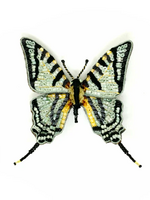
- A natural companion to the Scarce Swallowtail for a curated butterfly pairing that spans the spectrum from graphic monochrome to jewel-dark iridescence
- Display in the keepsake box as a decorative object, the iridescent blue-black surface is most striking when lit from above
- Converts to a pendant necklace with a bail adapter, available separately on Amazon
Batesian Mimicry, Beauty as Deception
The Red-Spotted Purple is one of North America's most celebrated examples of Batesian mimicry, the evolutionary strategy in which a harmless species gains protection from predators by closely resembling a toxic or unpalatable one. The model in this case is the Pipevine Swallowtail, a butterfly whose caterpillars feed on Aristolochia plants containing toxic aristolochic acids that make the adult butterfly genuinely unpalatable to birds. By evolving a similar dark iridescent blue-black appearance, the Red-Spotted Purple has gained protection from bird predators without the metabolic cost of producing toxins itself.
Research has confirmed that birds conditioned to avoid Pipevine Swallowtails also avoid Red-Spotted Purples, demonstrating that the mimicry is functionally effective. The butterfly's extraordinary beauty is, in part, a survival strategy — it has evolved to look dangerous.
The Red-Spotted Purple in Texas
The Red-Spotted Purple is found across eastern and central Texas, inhabiting woodland edges, river bottoms, and valley habitats from the Piney Woods of East Texas through the Edwards Plateau. It is a species that rewards the patient observer, basking with wings spread flat on sun-warmed surfaces in woodland clearings and along forest paths. For Texas naturalists and butterfly enthusiasts it is a genuinely exciting encounter, a large, dark, iridescent butterfly that seems to absorb and refract light simultaneously.
The Perfect Gift
The Red Spotted Purple is one of the most sophisticated and darkly beautiful pieces in the Trovelore butterfly collection. It works for Lepidoptera enthusiasts who know and appreciate this species, for Texas naturalists who have encountered it in the field, for lovers of jewel-toned and iridescent jewelry in deep blue-black and purple, for anyone fascinated by the science of mimicry and evolutionary biology, and for the person in your life who wants a butterfly brooch that is genuinely unlike any other in its palette and character. The complete keepsake presentation means it arrives ready to give.
FAQs
What is the Red-Spotted Purple butterfly?
Limenitis arthemis astyanax is a subspecies of the White Admiral butterfly found across the eastern United States, including Texas. It inhabits woodland edges, river valleys, and coastal plain habitats, basking with wings spread flat on sun-warmed leaves and paths. It is known for its deep iridescent blue-black upperside with warm brick-red forewing spots and a vivid iridescent postmedian band across the hindwings, and for being a celebrated example of Batesian mimicry of the toxic Pipevine Swallowtail.
What is Batesian mimicry and how does the Red-Spotted Purple use it?
Batesian mimicry is an evolutionary strategy in which a harmless species evolves to resemble a toxic or unpalatable one, gaining protection from predators without the cost of producing toxins itself. The Red-Spotted Purple closely resembles the Pipevine Swallowtail, a butterfly whose caterpillars feed on toxic Aristolochia plants, making the adult genuinely unpalatable to birds. Birds conditioned to avoid Pipevine Swallowtails also avoid Red-Spotted Purples, making the mimicry functionally effective.
Is the Red-Spotted Purple found in Texas?
Yes. The Red-Spotted Purple is found across eastern and central Texas, inhabiting woodland edges, river bottoms, and valley habitats from the East Texas Piney Woods through the Edwards Plateau. It is a rewarding species for Texas butterfly enthusiasts, a large, dark, iridescent butterfly that basks with wings spread flat in woodland clearings and along forest paths.
How large is this brooch?
The Red Spotted Purple Butterfly Brooch Pin measures 1.8" tall by 2.75" wide (4.7 cm x 7 cm), a horizontally oriented piece that reflects the butterfly's characteristic open-winged basking posture with forewings angled forward and hindwings spread flat.
What does it arrive in?
Every Red Spotted Purple Butterfly Brooch Pin arrives in Trovelore's embossed keepsake box with a story card. It is ready to gift exactly as it arrives.
What is your return policy on preorder items?
Our standard 14-day return policy applies to this item. Returns are accepted within 14 days of delivery for store credit. If you have questions about the piece before purchasing, please reach out and we will do our best to help.